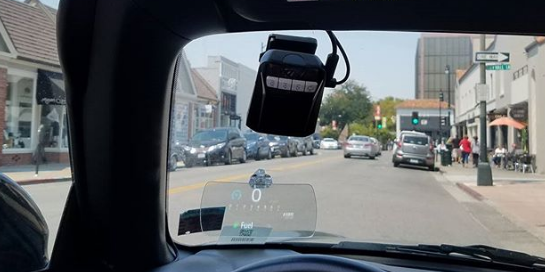
Heads-up displays (HUDs) have become increasingly popular devices because they allow drivers to access valuable information and data without turning their eyes away from the road.
Hudly is a heads-up display that uses a mounted projector to access notifications, navigation and vehicle information including driving speed and gas levels. It projects the user’s smartphone content on the windshield, in his or her line of sight, and provides the ability to access favorite Android or iOS apps. Hudly works in any car that has either an On-board diagnostics (OBD)-II port or cigarette lighter adapter. The powerful projector is capable of 14,000 nits, allowing it to be viewable in even bright daylight, according to its makers. Hudly ships in January at future pricing of $299. But Indiegogo backers have been able to order one for a pledge starting at $199 for early birds. Its makers hope to raise $50,000 by Oct. 28.
The main challenge facing Hudly is that there are so many similar products, including the similar-sounding Hudway Glass. Features that might give Hudly an edge over at least certain rival devices is its optical glass combiner that its makers say makes the device’s image crisp. The special coating and curved lens improves optics and displays a virtual image size of 10.8 inches that appears as if it it’s 7 feet ahead of the driver. A potential negative is that Hudly is only compatible with a limited number of smartphones: iPhone 4+ and higher or Android OS 4.2 and higher.
 FenSens
 Distracted driving remains a major problem that causes many needless accidents. Dashboard mounts for smartphones don’t really resolve the issue because they still require drivers to take their eyes off the road to look at their devices. Heads-up displays, meanwhile, tend to be costly, typically focus only on driving-specific information, and have raised their own set of safety concerns.
 Radiomize
 Carrying items on a car roof rack is convenient when a pick-up truck isn’t an option, but pricy if the driver forgets that the cargo is up there and zooms through a height restriction warning. Such was the case for a couple of hungry cyclists whose focus was overcome by their growling stomachs and the restaurant that was just up ahead. Hence: the invention of